
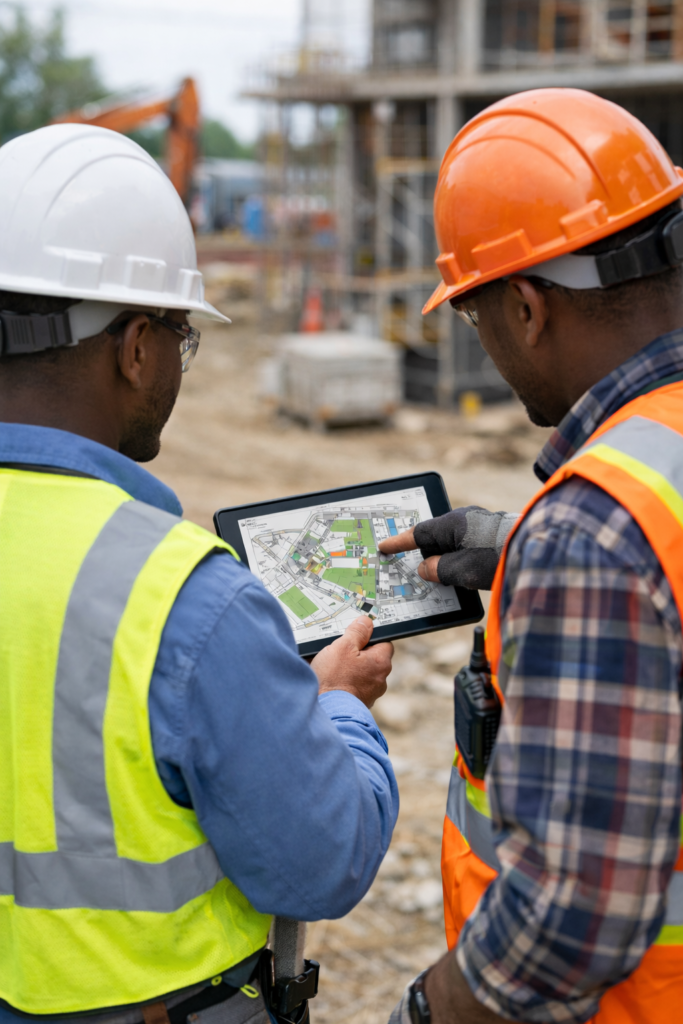

How Artificial Intelligence Enhances Construction Risk Assessment for Occupational Health and Safety Professionals
Introduction
Construction risk assessments are conducted in environments characterized by rapid change, multi-employer interfaces, variable site conditions, and high-risk activities. Despite established methodologies (e.g., JSA/JHA, TRA, RAMS), unforeseen risks still emerge due to incomplete hazard visibility, inconsistent assessments, and delays between site change and reassessment.
Artificial Intelligence (AI) can materially improve construction risk assessment quality by:
increasing the detection of weak signals before incidents occur, improving consistency in risk estimation, strengthening control selection through structured decision support, and enabling dynamic review as work conditions evolve.
Where “Unforeseen Risk” Typically Originates in Construction
In construction, “unforeseen” risk is frequently the result of common systemic conditions rather than random events. Typical contributors include:
Uncontrolled change: scope changes, resequencing, design revisions, temporary works modifications, or altered access/egress
Interface complexity: simultaneous operations (SIMOPS), multiple contractors, and shared work zones
Inconsistent RAMS/JSA quality: variation in hazard identification depth, control clarity, and verification steps
Lagging information flow: near-misses and minor deviations not escalated promptly (or not documented)
Site variability: weather, ground conditions, visibility, noise, congestion, and restricted space constraints
AI supports earlier recognition of these conditions by analyzing data at scale and identifying patterns that are not apparent through manual review.
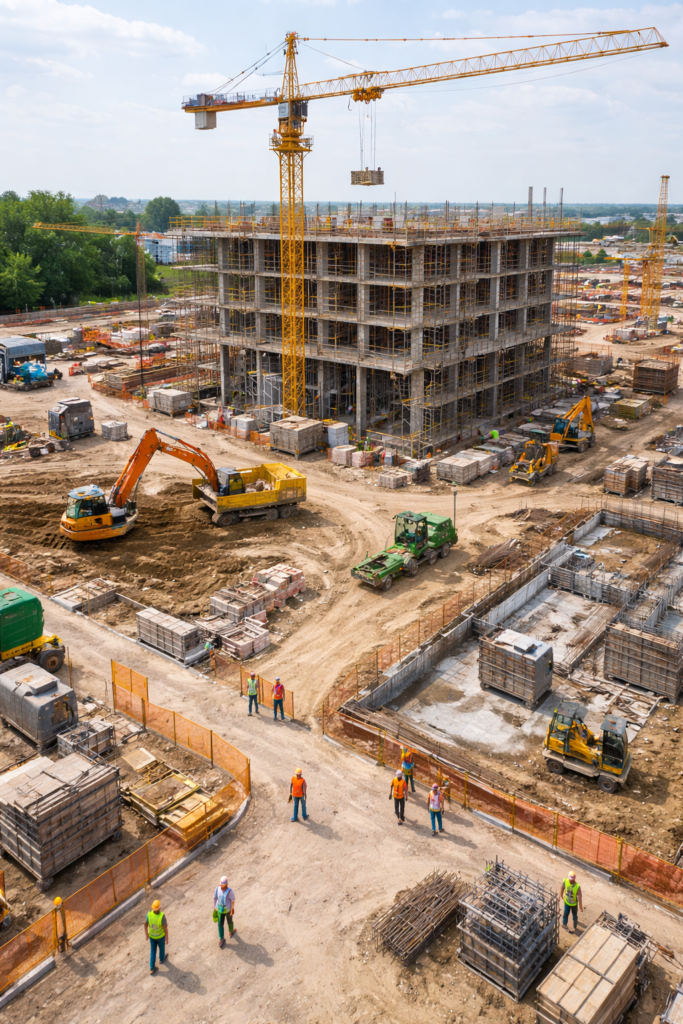
Multiple contractor activities and SIMOPS on a construction site
Enhanced Hazard Identification (Technical Application)
Natural Language Processing (NLP) on Safety and Operational Records
Construction generates significant unstructured text data, including: incident and near-miss narratives, daily reports, permit-to-work notes, inspection findings, toolbox talk records, supervisor observations, and audit comments.
NLP can be used to:
Extract hazard themes (e.g., dropped objects, plant–people interface, temporary edge exposure)
Identify recurring causal factors (e.g., poor segregation, time pressure, inadequate supervision, access constraints)
Detect repeated locations and tasks associated with deviations (e.g., loading zones, hoist landings, lift points)
Flag missing critical elements in assessments (e.g., no mention of exclusion zones, lifting plans, wind limits)
Practical value: improved completeness and consistency of hazard identification across projects, shifts, and contractors.
.
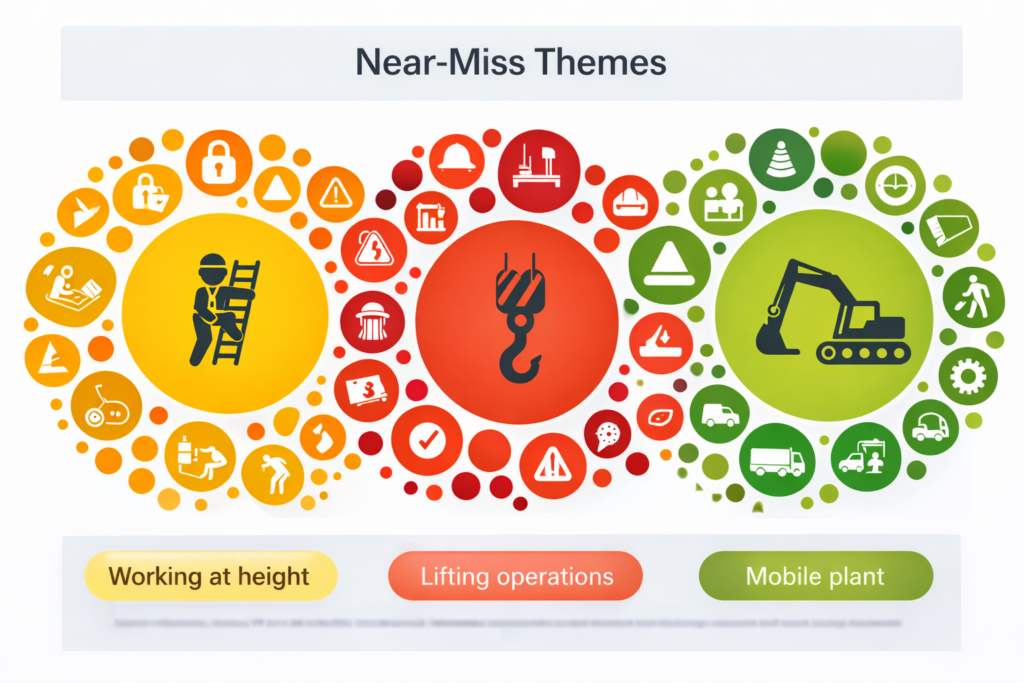
AI categorizing construction safety observations into hazard themes
Computer Vision for Observable Risk Conditions (With Governance Controls)
Where permitted by policy and local regulation, AI-enabled computer vision may support detection of visible unsafe conditions such as:
PPE compliance trends, Unauthorized access to restricted zones, Proximity events between pedestrians and mobile plant, Temporary barrier breaches, Repeated congestion in key routes and work fronts.
Important: This capability must be implemented with strict privacy controls, transparency to the workforce, and a prevention-focused approach (system improvement rather than punitive monitoring).
.
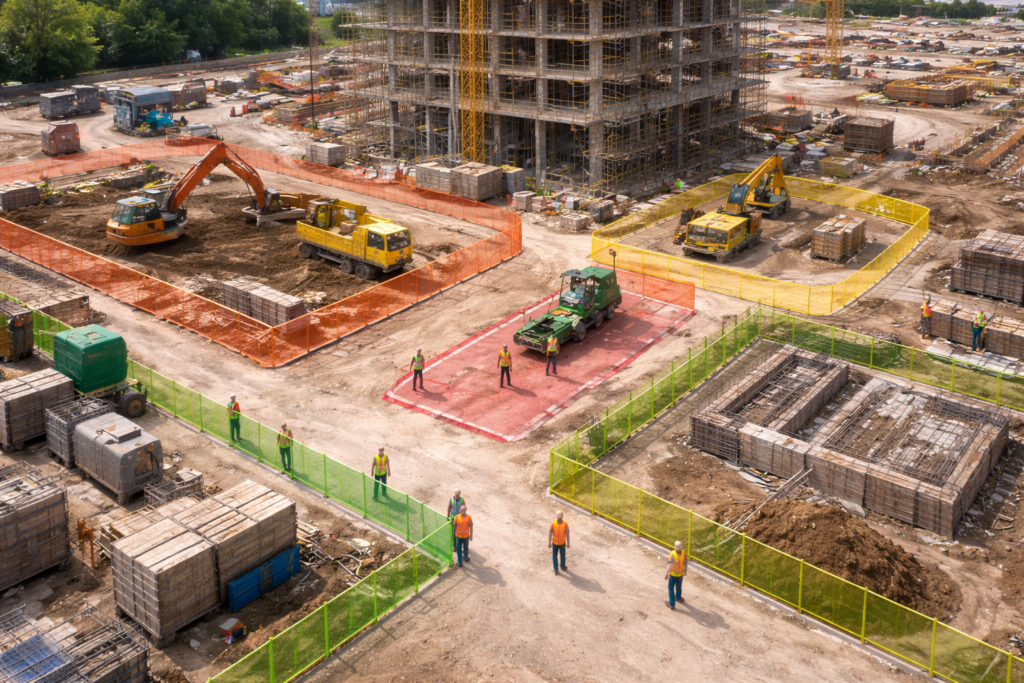
Monitoring of access control and exclusion zones for construction safety
Improved Risk Estimation (Likelihood, Exposure, and Variability)
Risk matrices often fail when likelihood is treated as subjective rather than evidence-informed. AI enables a more data-driven approach to risk estimation by integrating leading indicators.
Leading Indicator Integration. AI can analyze leading indicators such as:
Near-miss frequency and severity proxies, Permit deviations (e.g., isolations not verified, constraints not met), Inspection findings and close-out delays, Plant maintenance backlogs, Rework rates and schedule compression, Overtime patterns and shift coverage changes, Weather triggers relevant to the task (wind for lifts, rain for slips/ground instability).
Outcome: risk ratings become better aligned with current operating conditions rather than static assumptions.
Dynamic Risk Assessment Triggers
AI can support “dynamic” reassessment by detecting conditions that should trigger review, for example:
Workfront changes, new trades entering a zone, SIMOPS escalation
Revised lifting plans or temporary works changes, Abnormal congestion near crane pick zones or delivery routes, Adverse weather crossing defined limits for the activity, Repeated near-misses of the same type within a short period
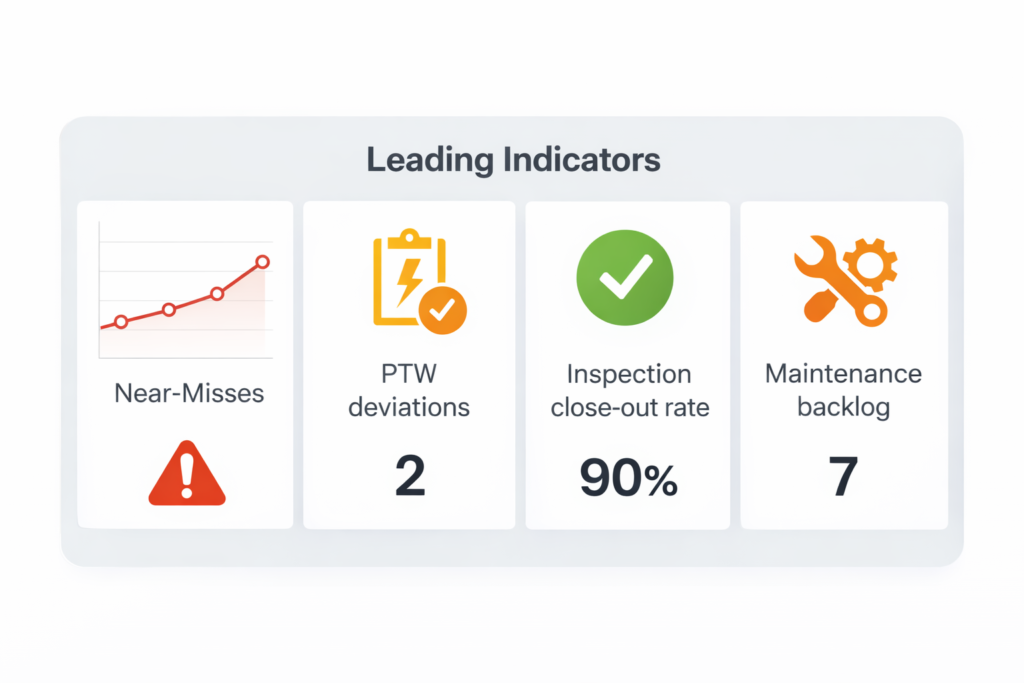
Leading indicators supporting dynamic construction risk assessment.
Stronger Control Selection and Verification (Hierarchy of Controls)
In construction, control failure often arises from controls being: poorly specified, not verified, incompatible with the work sequence, or not maintained under change. AI can provide structured decision support to strengthen control selection and clarity. Control Recommendations Mapped to the Hierarchy of Controls, A well-configured AI assistant can prompt assessors to consider higher-order controls before relying on administrative controls and PPE.
Examples:
Elimination/Substitution: prefabrication to remove work at height; alternative access methods, Engineering controls: designed edge protection, engineered lift points, physical segregation barriers, Administrative controls: exclusion zones, lift plans, permits, sequencing, supervision ratios
PPE: last-line defense, task-specific, verified fit/condition, Control Quality Checks (Technical Completeness), AI can review RAMS/JSA content to check for:
Defined responsibility (who implements and verifies each control), Measurable limits (e.g., wind thresholds, exclusion distances, load limits), Interface controls (SIMOPS coordination, traffic management integration), Verification steps (inspections, sign-offs, hold points, permit validations)
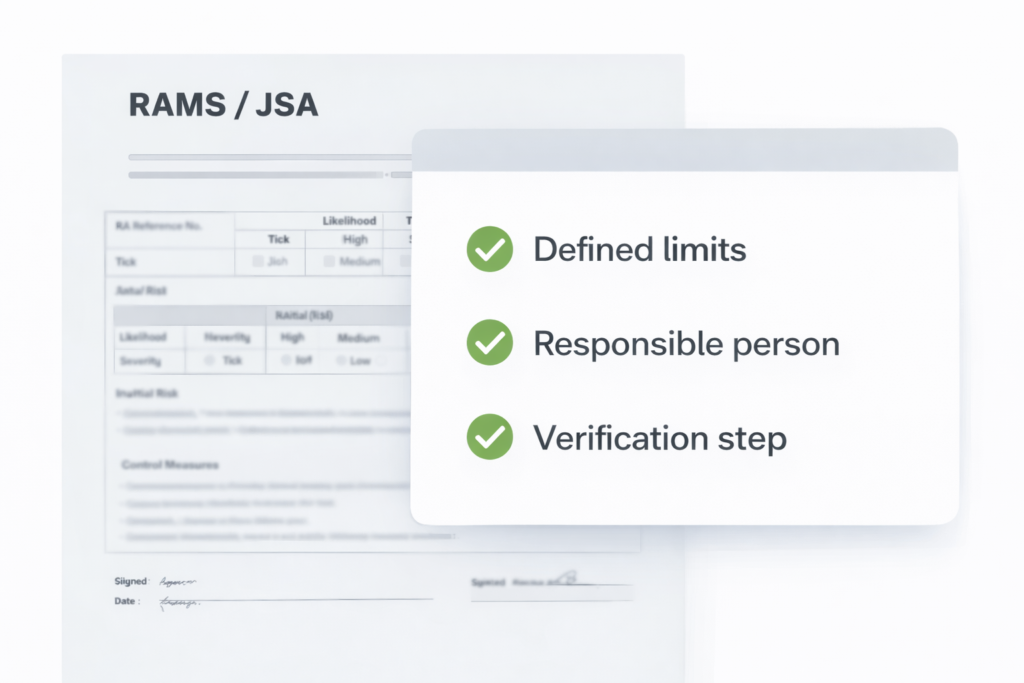
Improving RAMS quality through structured control verification
Continuous Monitoring of Control Effectiveness (From Static to Living Assessments)
Construction sites evolve daily. A risk assessment is only valid if it remains aligned with real conditions.
AI can support ongoing control effectiveness monitoring by:
linking incident/near-miss recurrence to specific controls and locations, identifying controls frequently bypassed (e.g., temporary barriers moved, routes blocked), highlighting overdue actions, inspections, or permit reviews, correlating nonconformances with schedule pressure or work front transitions
Result: earlier intervention before control drift results in a serious event.
Suggested image (after this section):
A site inspection scene: supervisor checking edge protection or exclusion barriers with a digital checklist.
High-Value Construction Use Cases (Operational Examples)
Work at Height (WAH)
AI-supported improvements may include: identification of recurring edge exposure near specific work fronts, detection of repeated temporary access deviations (ladders, scaffold incomplete tags), control prompts for inspection frequencies and supervision requirements
Suggested image:
A compliant work-at-height setup (guardrails, toe boards, access control).
Lifting Operations and Crane Activities
AI can support: trend analysis of lift plan deviations and near-misses, identification of congestion patterns near pick-and-carry routes, dynamic triggers for wind limits and exclusion zone compliance
Mobile Plant and Traffic Management. AI can help: map pedestrian–plant interaction hotspots, evaluate route changes and congestion based on delivery schedules, detect repeated near-collision reports by location and time window
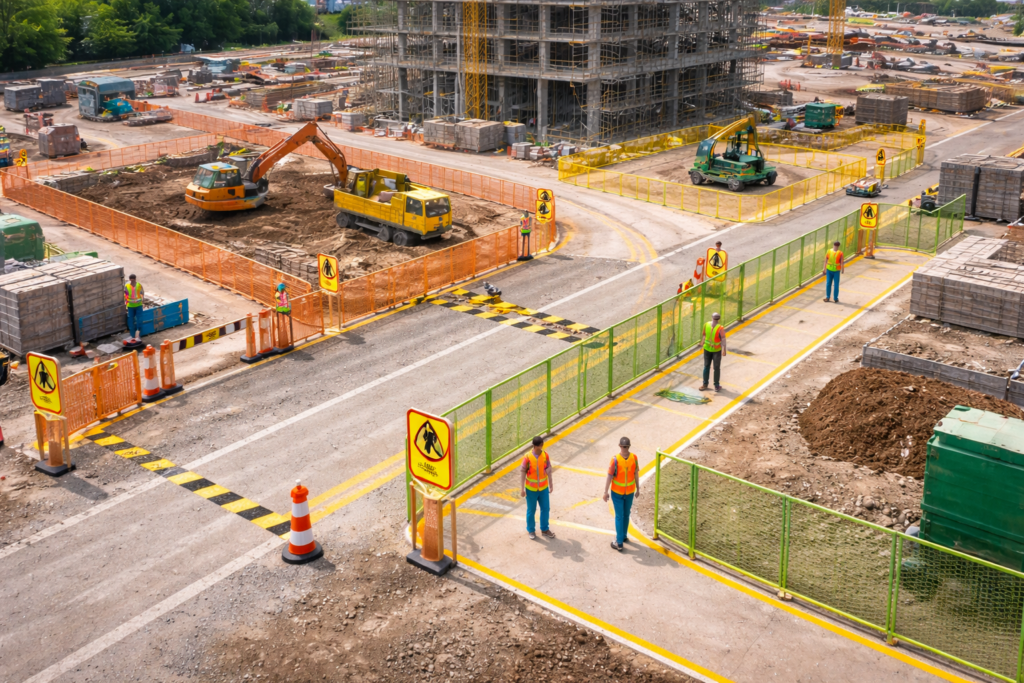
Traffic management controls separating pedestrians and plant.
Implementation Requirements and Governance (Construction Context)
To ensure AI improves risk assessment without introducing new risks, the following controls are recommended: Human-in-the-loop decision making: AI provides recommendations; competent persons approve risk ratings and controls, Data governance: defined sources, retention, access permissions, and anonymization where required, Model transparency: outputs must be explainable and auditable (avoid untraceable “risk scores”), Workforce consultation: clear communication on what is collected, why, and how it is used, Quality assurance: periodic review against actual site outcomes, including false positives/negatives, Regulatory alignment: confirm consistency with applicable construction safety legislation, standards, and client requirements
Recommended Adoption Roadmap for OHS Teams in Construction
Select one priority use case (e.g., near-miss clustering for plant interactions), Standardize data inputs (consistent hazard taxonomy, locations, work packages, contractor identifiers), Pilot on one project with defined KPIs (assessment completeness, review frequency, close-out time, near-miss recurrence), Integrate into existing workflows (PTW, RAMS approvals, daily briefings, inspections), Establish governance and training (privacy, acceptable use, interpretation limits), Scale across projects once quality and acceptance are validated
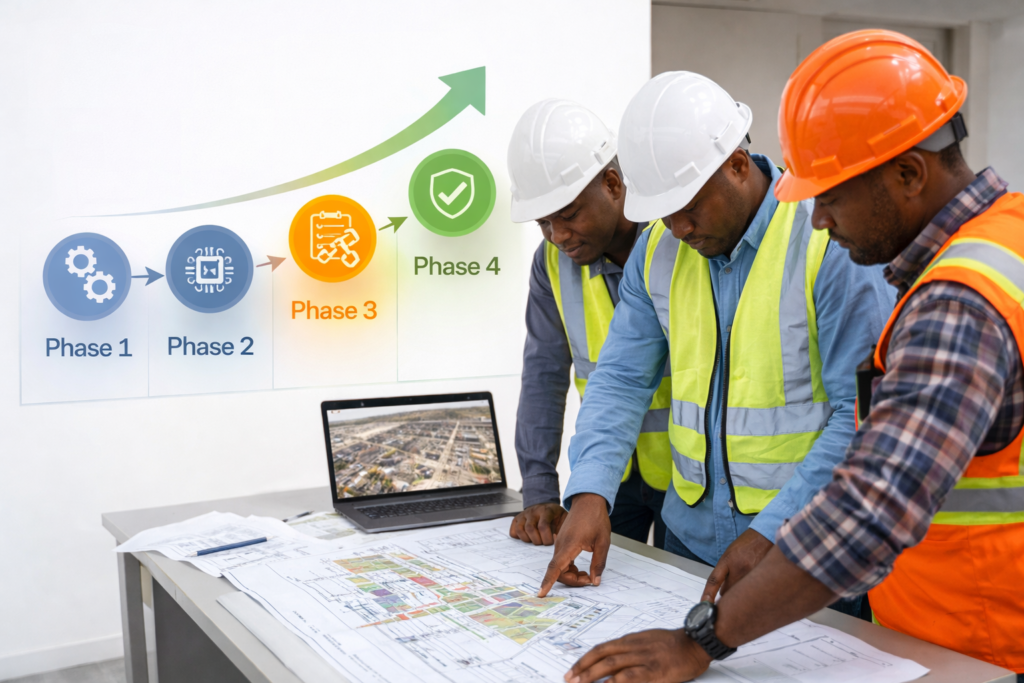
Phased implementation of AI-supported construction safety processes
Conclusion
AI can significantly enhance construction risk assessment by improving hazard identification, strengthening evidence-based risk estimation, increasing control quality, and enabling continuous review under change. The most effective implementations treat AI as a technical decision-support tool within a governed system—where competent OHS professionals retain accountability for risk decisions and control verification.
When deployed responsibly, AI reduces the probability of emergent and unforeseen risks by detecting weak signals early and maintaining alignment between documented controls and actual site conditions.