
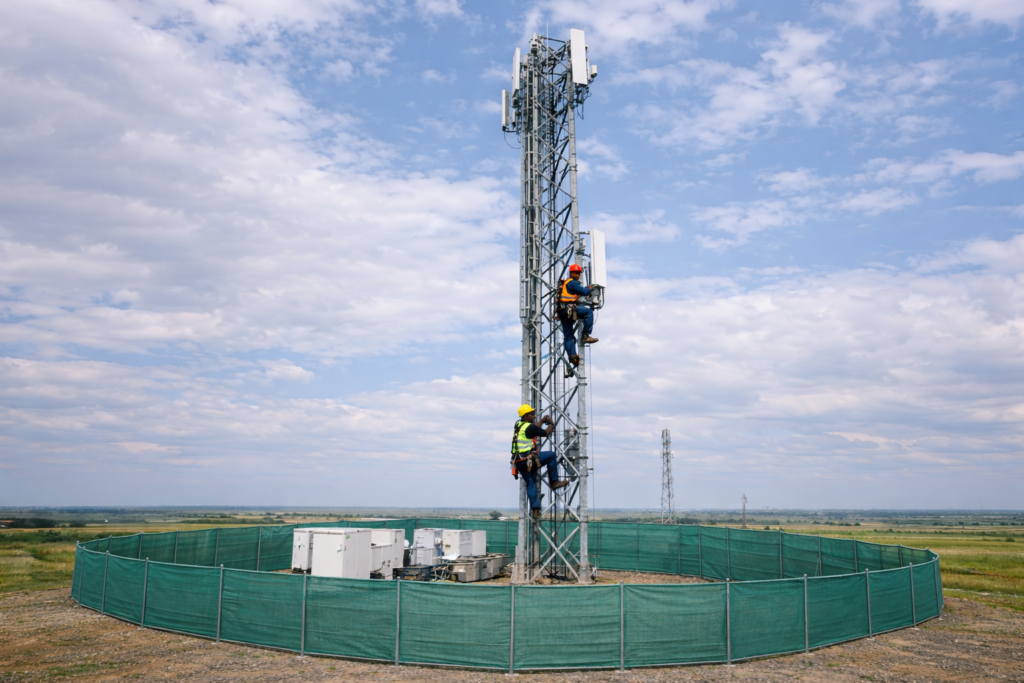

Preventing Accidents in Cellular Tower Construction through Effective Risk Assessment
Cellular tower construction sits at the intersection of heavy civil works, complex lifting operations, electrical installation, and high-risk work at height. It is also uniquely exposed to change. A tower site can shift from safe to hazardous in minutes when wind increases, ground conditions soften after rain, a crane is repositioned, a delivery arrives early, or a subcontractor brings different equipment than expected. In this environment, strong safety outcomes are rarely driven by luck or slogans. They come from disciplined planning, clear controls, and the ability to recognize and manage change in real time.
Two risk management practices are especially powerful in preventing accidents in telecommunications infrastructure projects: the Baseline Risk Assessment (BRA) and the Dynamic Risk Assessment (DRA). The baseline assessment establishes the safe system of work before the project begins. Dynamic assessment keeps that system valid as conditions evolve. When these two processes are properly linked, when the daily and moment-to-moment decisions on site are anchored to a detailed baseline plan, the project gains a practical, repeatable method to prevent serious harm.
This article explains what a detailed baseline risk assessment is in the context of cellular tower construction, how it prevents accidents, what dynamic risk assessment looks like in day-to-day site operations, and how both should be integrated into a single safety management approach that is credible, auditable, and effective.
Why Cellular Tower Construction Demands Stronger Risk Management
Tower construction is unforgiving because consequences are high and recovery time is low. Falls from height, contact with electricity, dropped objects, crane incidents, vehicle rollovers, excavation collapse, and uncontrolled energization can all lead to severe injury or fatality. The work is often carried out under schedule pressure, with multiple contractors and specialist crews arriving at different times. Sites can be remote, which delays emergency response and makes communication harder. Weather and wind are not just discomfort factors; they are critical safety variables. Even “routine” tasks like moving materials, routing cables, or installing brackets become high risk when conducted 30–60 meters above ground, or when performed inside an exclusion zone during lifting.
The common thread behind many major incidents is not a lack of awareness that the work is dangerous. It is the failure to manage change. A lift plan that is safe on dry ground becomes unsafe after heavy rain. A fall protection plan that assumes a continuous climbing system becomes unreliable when a section is modified or when an anchor is obstructed by new steel. A traffic plan that works during quiet hours breaks down when deliveries overlap with excavation work. These are not rare events; they are normal features of tower projects.
This is why risk assessment in telecom infrastructure must be both deep (baseline) and adaptive (dynamic). Baseline creates stability. Dynamic protects that stability when the environment shifts.
Baseline Risk Assessment in Tower Construction: What It Is and What “Detailed” Means
A Baseline Risk Assessment is a structured, pre-work evaluation that defines how a tower project will be executed safely. It is completed before mobilization or before high-risk activities begin, and it forms the reference point for permits, method statements, lift plans, training requirements, inspection regimes, and emergency response planning.
A baseline risk assessment becomes “detailed” when it goes beyond generic lists and is built around the real site and real scope. That means it considers the actual tower type (guyed mast, lattice tower, monopole), the actual construction method (section-by-section erection, gin pole, crane-assisted picks), the actual access limitations, the actual ground conditions, and the actual interfaces with power lines, public areas, or other infrastructure. It includes the practical controls that can be implemented, verified, and enforced, and it assigns clear responsibility for each control.
A credible baseline risk assessment in cellular tower construction typically covers the full project lifecycle: site access and mobilization, excavation and foundations, tower erection and structural works, antenna and feeder installation, power and grounding, commissioning and testing, and demobilization. It anticipates interfaces between contractors and trades and identifies where simultaneous or concurrent operations will occur. It defines not only “what could go wrong” but also “what must be true for the work to be allowed to proceed.”
In this sense, the baseline assessment is not a standalone document. It is the foundation for the project’s safe system of work.
How Baseline Risk Assessment Prevents Accidents: The Mechanisms That Matter
A detailed baseline risk assessment prevents accidents through several concrete mechanisms that can be observed on real projects.
First, it removes ambiguity. Many unsafe acts occur when workers or supervisors interpret risk differently, or when expectations are not clear. A baseline plan sets consistent standards: when climbing is permitted, what wind thresholds apply, where exclusion zones must be erected, what inspection checks must be done, who is allowed to rig, who authorizes energization, and what “stop work” conditions look like. Clarity reduces improvisation, and improvisation is a common precursor to incidents.
Second, it front-loads control selection. On tower projects, it is far easier to prevent risk by design than to rely on PPE or last-minute administrative controls. Baseline planning enables engineering controls like creating a stable crane pad, specifying outrigger mats, installing temporary edge protection where possible, choosing appropriate anchor systems, and ensuring safe access routes before the work begins. When controls are engineered and pre-positioned, compliance improves because the safe choice becomes the easy choice.
Third, it identifies site-specific hazards early, including hazards that are easy to miss. A tower site may present unstable soil, hidden culverts, proximity to overhead powerline, or limited laydown space that forces unsafe stacking of materials. Remote sites may have weak communications coverage, long medical evacuation times, and limited water or shade for crews, increasing fatigue and heat stress risk. Baseline assessment makes these hazards visible early, allowing realistic planning instead of reactive correction.
Fourth, it enforces competency and role definition. Tower work is specialist work. A baseline risk assessment should specify the minimum competency for climbers, riggers, signalers, crane operators, and electricians. It should also define who leads the lift, who controls the exclusion zone, and who has authority to stop work. Clear roles prevent the “everyone thought someone else was in charge” failure mode.
Fifth, it builds emergency response into the plan, especially rescue at height. Many projects mention rescue, but fewer operationalize it. A detailed baseline assessment links rescue planning to actual site conditions, staffing levels, equipment availability, and realistic response times. It ensures that if a worker is suspended, the team is not forced to invent a rescue method under stress.
These mechanisms reduce both the probability of an incident and the severity if something does occur.
Core Tower Construction Hazards Addressed by Baseline Risk Assessment
Baseline risk assessment is most effective when it confronts the highest-risk parts of tower construction with practical controls.
In working at height, the baseline plan should establish the full fall protection strategy: the access method, attachment requirements, anchor systems, inspection routines, supervision, and rescue arrangements. It should define how 100% tie-off is achieved at each stage of erection, not just in theory. It should also address weather-related constraints such as wind speed thresholds, lightning risk management, and visibility limitations, because climbing safety is highly sensitive to these conditions.
For dropped object prevention, baseline planning should define exclusion zones, tool tethering standards, secure storage of small components, and rules around working under load. It should also address housekeeping at height and material control, since loose items on platforms and in pockets become hazards when crews move and reposition.
For lifting operations, a baseline assessment should require lift planning commensurate with the lift’s complexity and consequence. It should define how load weights are confirmed, how crane capacity at the required radius is verified, how ground bearing is assessed, how rigging is selected and inspected, and how communications are controlled. It should anticipate proximity to overhead power lines and define safe approach distances and movement restrictions to prevent contact.
In excavation and foundation work, baseline assessment should cover permit-to-dig requirements, utility detection, trench protection, access and egress, and plant–people separation. It should address concrete handling hazards and formwork stability, as well as traffic flow around excavation areas.
In electrical works, baseline assessment should set rules for lockout/tagout, test-before-touch practices, temporary power management, grounding and bonding requirements, and commissioning controls. It should define competency requirements and the permit process for energization.
Finally, baseline planning must include transport, access, logistics, and remote work risks. Vehicle incidents and delayed emergency response are common contributors to severity in remote tower sites. A baseline plan that includes access route assessment, vehicle suitability, fatigue management, and emergency evacuation planning is often the difference between a managed event and a tragedy.
Dynamic Risk Assessment: The Missing Link Between Planning and Reality
If baseline risk assessment is the project’s safety blueprint, Dynamic Risk Assessment is the practice of keeping that blueprint valid as conditions change. Dynamic risk assessment is a continuous or frequent process of evaluating the current situation, identifying new hazards or changes in risk, and adjusting controls accordingly before proceeding. It is sometimes described as “Stop–Think–Assess–Respond,” but on professional sites it is more than personal awareness. It is a structured habit built into supervision, permits, and daily decision-making.
Dynamic risk assessment matters in tower construction because site conditions are not static. Wind increases as the day warms. Rain softens ground and changes crane stability. The crane’s working radius changes when the operator repositions. A new subcontractor arrives with different tools or different competency. A component arrives late and forces sequencing changes. Even a small change like moving the laydown area closer to the tower can create new dropped-object exposure or traffic conflict.
In these moments, the baseline risk assessment remains essential, but it is not sufficient on its own. Baseline planning can predict many hazards, but it cannot predict every change. Dynamic risk assessment is how a crew recognizes that today’s conditions differ from the baseline assumptions and how they decide whether the job can continue safely, requires new controls, or must pause.
How Dynamic Risk Assessment Works on a Tower Site
Dynamic risk assessment is not meant to be complicated. It must be fast enough to use, but disciplined enough to be reliable. On a well-managed tower project, dynamic risk assessment is embedded into the daily routine in several ways.
It begins at the start of the shift with a pre-task briefing, where the supervisor reviews the baseline plan and method statement and then asks what has changed since the last shift. The crew confirms current weather, ground conditions, site access, equipment status, and simultaneous operations. If anything differs from the baseline assumptions, the plan is adjusted before work proceeds.
During the shift, dynamic assessment occurs at decision points, such as before lifting, before climbing, before entering an exclusion zone, before excavating in a new area, and before energizing equipment. These are the points where a “quick check” can prevent a major incident. The check looks at immediate hazards: wind and lightning risk, stability of the working surface, changes in crane radius, the presence of unauthorized people near the tower, new vehicle movements, or new obstructions that affect tie-off.
Dynamic assessment also includes stop-work triggers and escalation rules. A site does not rely on individuals quietly accepting unsafe conditions. It normalizes stopping work when conditions exceed predefined thresholds, such as wind limits for climbing, lightning proximity, poor visibility, loss of communication with climbers, discovery of unmarked utilities, or equipment malfunction.
Finally, dynamic risk assessment is sustained through continuous monitoring and feedback, including near-miss reporting and quick learning loops. If a near-miss happens such as a tool slipping but being caught by a lanyard, or a vehicle nearly entering an exclusion zone, the site uses it as a signal that controls need strengthening immediately, not later.
The Link Between Dynamic and Baseline Risk Assessment
The strongest accident prevention happens when baseline and dynamic risk assessments are treated as one connected system rather than two separate activities.
The baseline risk assessment sets the original assumptions, hazards, and controls. Dynamic risk assessment tests whether those assumptions remain true in the moment. When dynamic assessment identifies a change, it should not just result in an informal workaround. It should trigger one of three actions: proceed with the baseline controls if conditions still match, proceed with additional controls if risks have increased, or stop and formally revise the method if conditions exceed what the baseline plan can safely manage.
This linkage works best when the baseline assessment explicitly defines the conditions under which it is valid. For example, the baseline plan might state that tower climbing is permitted only below a specified wind speed and outside a defined lightning risk radius. It might state that critical lifting is permitted only when crane setup is on verified ground conditions with outrigger mats and when the exclusion zone can be fully controlled. It might specify that excavation can proceed only after utility detection is completed and a permit is issued. These baseline conditions create clear “go/no-go” criteria that dynamic assessment can check quickly.
Dynamic risk assessment also feeds back into baseline planning. If dynamic assessments repeatedly identify the same change such as regular afternoon wind peaks, recurring access congestion, or frequent interference between deliveries and lifting, then the baseline assessment and work plan should be updated to reflect that pattern. Over time, the baseline becomes more accurate, and dynamic checks become more focused.
In professional safety management terms, baseline assessment is the planned control environment, while dynamic assessment is the real-time verification and adjustment mechanism. Together they form a closed loop.
Practical Scenarios Showing the Baseline–Dynamic Connection
Consider a crane-assisted lift of Mono pole tower sections. The baseline assessment may have identified lifting as a critical risk and required a lift plan, certified rigging, controlled communication, and a stable crane pad. On the day of the lift, dynamic assessment becomes decisive. If rain has softened the ground since the crane pad was prepared, the dynamic assessment should identify that the baseline assumption about stability no longer holds. The correct response is not to “be careful,” but to stop, reassess ground bearing, add mats or improve the pad, and verify crane stability before proceeding. In this example, the baseline prevents an unplanned lift, and the dynamic assessment prevents a planned lift from proceeding under changed conditions.
In another example, the baseline plan might specify wind thresholds for climbing and a lightning rule. During the shift, wind increases and gusts become stronger around the tower structure due to terrain effects. A dynamic assessment triggers a pause, and the supervisor decides to stop climbing and switch to ground-based tasks. Here, baseline defines the rule; dynamic enforces it under real conditions. Without the baseline thresholds, the decision becomes subjective. Without dynamic assessment, the threshold is ignored because no one checks it.
A third example involves dropped objects. The baseline assessment defines exclusion zones and tool tethering. During work, an unplanned delivery arrives and tries to enter the laydown area, forcing a route that cuts through the exclusion zone boundary. Dynamic assessment identifies the breach risk, stops the delivery, and re-establishes the zone. If deliveries repeatedly create conflict, the site updates the baseline traffic and logistics plan. The baseline creates structure; dynamic protects it.
These scenarios illustrate a simple truth: most major incidents occur when baseline controls are weakened by real-world changes. Dynamic assessment is the process that detects and corrects that weakening before harm occurs.
Integrating Baseline and Dynamic Risk Assessment Into Site Systems
To be professional and effective, baseline and dynamic risk assessments must be integrated into everyday site controls rather than existing as paperwork.
A strong integration model links baseline risk assessment to the project’s method statements, permits to work, lift plans, and inspection checklists. The baseline assessment should inform what permits are required, what conditions must be verified, and what competencies are necessary. For instance, work-at-height permits should be tied to baseline requirements on wind limits, equipment inspections, and rescue readiness. Lifting permits should be tied to baseline requirements on crane setup verification, rigging inspection, exclusion zones, and communications.
Dynamic risk assessment should be integrated into pre-task briefings or toolbox and hold points. Hold points are specific moments when work cannot proceed until certain conditions are verified. In tower work, hold points might include approval of the crane setup, confirmation of weather conditions before climbing, verification of exclusion zones before lifting, confirmation of utility detection before excavation, and authorization before energization. By designing these hold points around baseline assumptions and requiring dynamic verification, the project reduces the likelihood of rushed decisions.
Supervision plays a critical role. The most robust paperwork is ineffective if supervisors cannot or will not enforce controls under pressure. Professional practice requires that supervisors are trained not only in technical work but also in risk recognition and decision-making under changing conditions. It also requires a visible, credible stop-work culture supported by management. Stop-work authority must be real, not symbolic, and it must be exercised without punishment when conditions warrant it.
Finally, auditing and learning must be part of the system. Baseline risk assessment should be reviewed after significant changes or after high-risk phases. Dynamic risk findings and near-misses should be recorded in a way that informs updates to the baseline plan. This is how the project improves as it progresses, rather than repeating the same weak spots.
What Professional “Good” Looks Like: Quality Indicators
A professional baseline risk assessment is recognizable by its specificity and its operational usefulness. It references the actual site, not generic language. It clearly describes controls that can be verified, not vague statements like “use caution.” It assigns responsibility and defines acceptance criteria, such as measurable weather limits, inspection requirements, and competence standards. It includes rescue planning that is realistic for the site’s staffing and equipment.
A professional dynamic risk assessment is recognizable by how it is practiced. Crews pause at decision points, supervisors ask structured questions about what has changed, weather and site conditions are actively monitored, and stop-work triggers are used. When changes occur, controls are adjusted or work is paused rather than continuing with hope. Dynamic assessment is not a one-time checklist; it is a pattern of behavior supported by site leadership.
When these indicators are present, accident prevention becomes systematic rather than dependent on individual caution.
Conclusion: A Single Safety System Built for Change
Cellular tower construction will always involve significant hazards, but the pathway to prevention is clear. A detailed Baseline Risk Assessment prevents accidents by designing a safe system of work before the project begins, ensuring that high-risk activities such as working at height, lifting, excavation, and electrical work are controlled through clear standards, engineered protections, competent personnel, and practical emergency readiness. A Dynamic Risk Assessment prevents accidents by protecting that safe system as conditions change, ensuring that real-time decisions about weather, ground stability, equipment condition, traffic movement, and simultaneous operations remain aligned with baseline assumptions and controls.
The connection between baseline and dynamic assessment is where professional safety performance is built. Baseline defines what “safe” looks like for the project. Dynamic confirms that the site still matches that definition in the moment, and when it does not, it triggers adjustment, escalation, or a stop. Together, they form a closed-loop risk management approach that is realistic for tower projects and strong enough to prevent serious harm even under schedule pressure and changing conditions.