
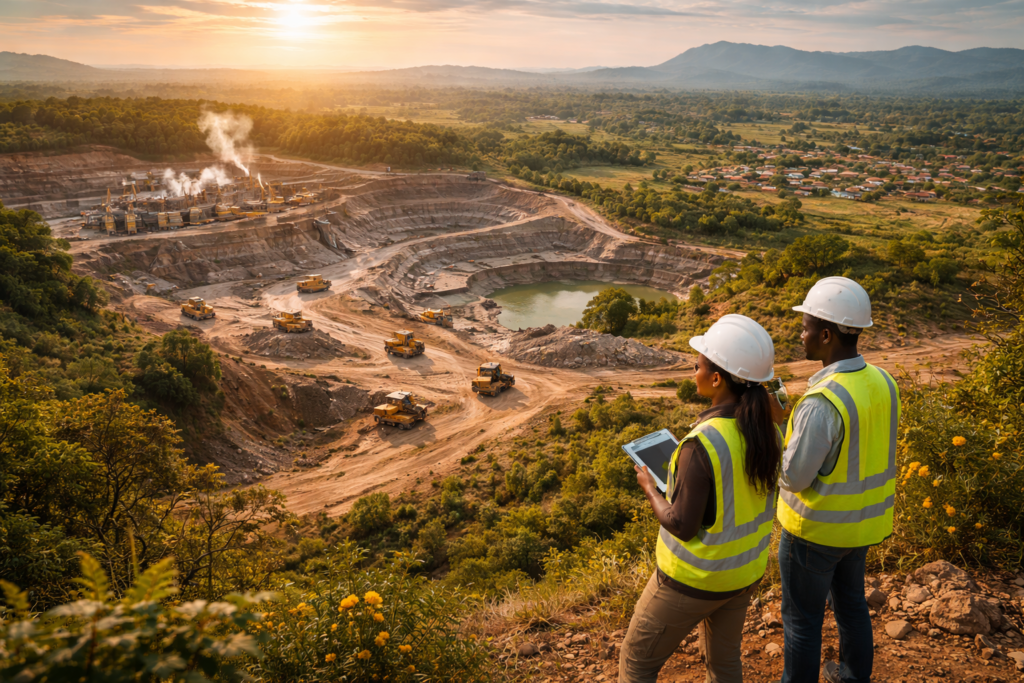

The Critical Importance of Comprehensive Environmental and Social Impact Assessment for Mining Projects in Africa
Mining is a cornerstone of economic development across many African countries, contributing to national revenue, foreign exchange earnings, infrastructure expansion, and employment. Yet mining projects are also among the most environmentally and socially consequential forms of development, often operating in sensitive ecosystems and complex community settings where impacts can extend far beyond the mine lease boundary and persist long after operations end. In this context, a comprehensive Environmental and Social Impact Assessment (ESIA) is not simply a permitting requirement. It is a professional decision-support tool that helps governments, investors, operators, and communities understand risk early, choose better project designs, and protect environmental and social systems that underpin long-term development.
A comprehensive ESIA is sometimes described as “wide scope” because it looks beyond obvious, short-term construction effects and considers the full area of influence, the full life cycle of the mine, and the full set of direct, indirect, and cumulative impacts. It evaluates environmental effects such as water use, pollution risk, biodiversity disturbance, land degradation, waste generation, and air emissions, while giving equal attention to social dimensions such as land access, livelihoods, cultural heritage, community health, resettlement risk, labor and working conditions, in-migration, community safety, and the distribution of benefits and burdens. When this breadth is built into assessment and planning from the outset, projects are more likely to achieve regulatory compliance, maintain a social license to operate, and remain resilient under changing climate, market, and governance conditions.
Why “Comprehensive” Matters in the African Mining Context
Africa’s mining regions are diverse, ranging from arid and semi-arid landscapes where water is scarce, to tropical forests with high biodiversity, to highland watersheds supporting dense downstream populations. In many areas, communities depend directly on ecosystem services for farming, grazing, fishing, and harvesting natural resources, meaning that changes to land and water systems can translate rapidly into livelihood and health impacts. At the same time, baseline environmental and social data can be limited, fragmented, or seasonal, which increases uncertainty if projects rely on generic assumptions or narrowly scoped studies. A comprehensive ESIA addresses this reality by investing in baseline studies that reflect local conditions and variability, and by translating those findings into practical impact predictions and management commitments.
Comprehensiveness also matters because the influence of mining rarely remains local. Roads, power lines, water pipelines, borrow pits, quarries, worker accommodation, and transport corridors can reshape land use patterns and settlement dynamics. Increased traffic can affect road safety and air quality along long routes, not only near the mine gate. In-migration can place pressure on housing, water points, health services, and local governance capacity. A wide-scope ESIA treats these changes as part of the project’s real footprint, because they often determine whether the project becomes a source of sustainable development or a trigger for long-term conflict and degradation.
Building a Baseline That Can Withstand Scrutiny
The credibility of an ESIA depends heavily on the quality of its baseline. A professional baseline is not merely a description of the current environment; it is a structured characterization of the conditions that matter most for risk, mitigation, monitoring, and accountability. In many African settings, seasonality is a defining feature of environmental behavior. River flows, flood patterns, groundwater recharge, dust levels, and ecosystem dynamics can vary significantly between wet and dry seasons. Social baselines also shift with seasonal livelihoods, market cycles, and mobility patterns, including pastoralist movements and temporary labor migration. A comprehensive ESIA therefore needs baseline studies that are designed to capture variability and local complexity rather than offering a single snapshot that can misrepresent true conditions.
When baseline work is strong, it improves the entire project pathway. It allows more accurate impact prediction, supports defensible permitting, strengthens monitoring design, and reduces disputes about “what changed” after operations begin. It also supports transparent engagement with communities and regulators because commitments can be linked to measurable indicators and clear thresholds rather than vague promises.
Cumulative Impacts and the Reality of Shared Landscapes
Many mining provinces in Africa host multiple operators and multiple forms of development, including agriculture, hydropower, forestry, expanding towns, and industrial corridors. In such settings, the combined pressure on water resources, ecosystems, and public services can become more significant than the impact of any single project. A narrow ESIA that evaluates only project-specific impacts may underestimate risk and contribute to slow, cumulative degradation that becomes visible only when it is difficult to reverse.
A comprehensive ESIA treats cumulative effects as a central concern, particularly for water availability, water quality, habitat fragmentation, and community service capacity. It considers existing pressures and reasonably foreseeable developments, and it assesses how the project interacts with regional systems such as shared watersheds, biodiversity corridors, and transport networks. This approach improves mitigation design, encourages coordination with government and neighboring operators, and supports more realistic decision-making about project scale, timing, and infrastructure choices.
Water, Waste, and Long-Term Pollution Risk Across the Mine Life Cycle
Water is often the most sensitive environmental and social issue in African mining projects, especially in regions with high climate variability and competing demands from communities, agriculture, and ecosystems. A comprehensive ESIA examines water risk across the life cycle, covering abstraction, recycling, discharge, stormwater management, and post-closure performance. It assesses surface water and groundwater interactions, downstream dependency, and the implications of both routine releases and accidental events. Where water stress exists or may worsen, the ESIA should support a water strategy that is technically sound, socially credible, and robust under drought and extreme rainfall scenarios.
Tailings and waste rock management further demonstrate why scope must be wide and life-cycle oriented. Tailings storage facilities and waste dumps represent long-term environmental risk and require integrated assessment that includes geochemical behavior, seepage pathways, potential for acid rock drainage, stability under extreme weather, operational controls, emergency preparedness, progressive rehabilitation, and closure design. A comprehensive ESIA ensures that waste risks are not treated as a narrow engineering topic but as a major environmental and social risk domain that demands governance, transparency, and long-term accountability.
Biodiversity, Ecosystem Services, and the Rising Importance of Nature-Related Risk
Many African mining regions contain high conservation value ecosystems, endemic species, migratory routes, and culturally significant landscapes. Biodiversity impacts are not limited to direct habitat loss within the mining footprint. Indirect effects such as fragmentation from roads and power lines, increased hunting pressure due to in-migration, noise and light impacts, and changes to water regimes can alter ecosystem function across wider areas. A comprehensive ESIA evaluates these effects through appropriate field surveys, ecological mapping, and impact pathways that reflect how ecosystems actually operate.
Equally important is the assessment of ecosystem services, which often underpin livelihoods and local resilience. Water provision, grazing resources, wild foods, medicinal plants, soil stability, and cultural and spiritual values associated with land can be affected even when formal land acquisition is complete. A wide-scope ESIA identifies these dependencies and designs mitigation around avoidance and minimization first, followed by restoration and, where appropriate, offsets aligned with national requirements and recognized good practice. This improves both environmental outcomes and social trust, because communities tend to evaluate projects based on lived impacts to resources and livelihoods, not only on legal boundaries.
Social Performance, Community Health, and Livelihood Integrity
Mining projects can transform local economies and social structures. They may create jobs and local procurement opportunities, but they can also disrupt land access, increase inequality, intensify competition for resources, and trigger conflict if expectations are not managed. A comprehensive ESIA places social performance at the core by assessing land and livelihood change, resettlement risk, vulnerable groups, gendered impacts, cultural heritage, community safety, labor influx, and the capacity of local services.
Community health is a key area where wide scope prevents harm. Dust, noise, traffic, water quality changes, vector ecology shifts, and pressure on sanitation systems can create health impacts that extend beyond the mine site. A comprehensive ESIA integrates health risk into impact prediction and management planning, and it supports practical measures such as traffic controls, dust suppression, water protection, emergency response coordination, and health system strengthening where appropriate. It also establishes a meaningful engagement process and a functioning grievance mechanism so concerns can be raised and resolved early, before they escalate into conflict and operational disruption.
Climate Change, Resilience, and the Future Operating Environment
Climate change and climate variability influence water availability, flood risk, heat stress exposure, and infrastructure resilience. In many parts of Africa, extreme events and rainfall uncertainty are increasing risk for both operations and communities. A comprehensive ESIA assesses climate-related risks to the project and to surrounding environmental and social systems, and it evaluates whether project design standards and management measures remain effective under plausible future scenarios. This improves safety, reduces the likelihood of environmental incidents during storms and floods, and supports more reliable long-term planning.
Comprehensive assessment also considers greenhouse gas emissions and energy choices, especially as financiers and supply chains increasingly expect credible emissions management. For mining projects connected to the global market, climate performance can influence access to capital, partnerships, and market acceptance. Integrating climate considerations into ESIA is therefore not only environmentally responsible but also strategically important for project viability.
Better ESIA Produces Better Decisions, Faster Permits, and Stronger Project Stability
A comprehensive ESIA strengthens outcomes for all stakeholders when it is used as a decision-making tool rather than a compliance product. For regulators, it provides clearer evidence on risks, trade-offs, and enforceable commitments. For communities, it offers a transparent process for understanding impacts, influencing mitigation, and protecting livelihoods and cultural values. For investors and lenders, it reduces environmental and social risk exposure and improves confidence that commitments can be implemented, monitored, and audited. For operators, it reduces surprises, prevents costly redesign late in the project, and lowers the risk of conflict-driven delays and disruptions.
In practical terms, a wide-scope ESIA helps prevent the common failure mode where projects discover critical constraints too late, such as sensitive habitats after design is fixed, water conflicts once operations begin, or resettlement complexity after schedules are locked. When risk is identified early, avoidance and minimization become feasible, stakeholder expectations are managed more credibly, and project systems can be designed to perform under real site conditions.
Conclusion
Mining can support development across Africa, but the durability of its benefits depends on how well environmental and social risks are understood and managed. A comprehensive Environmental and Social Impact Assessment is essential because it captures the full area of influence, reflects seasonal and local complexity, addresses cumulative and long-term effects, and integrates water, waste, biodiversity, ecosystem services, livelihoods, health, and climate resilience into one coherent framework for decision-making. When ESIA is truly comprehensive, it does more than secure a permit. It provides a defensible baseline, strengthens trust, improves project design, and supports mining operations that are safer, more resilient, and more sustainable over the full life cycle.