
When Buildings Fall, the System Has Already Failed
The recent building collapses in South C and Karen, Nairobi, are not just tragic events in the news cycle. They are a public warning that Africa’s construction safety culture is still dangerously fragile. Two sites, two collapses, lives lost and others injured, and yet the same hard questions return: are states failing the people, or are people failing the state?
From ASHEPA’s perspective, this is not an either-or debate. It is both. The state fails people when oversight is weak, inspections are inconsistent, enforcement is compromised, and stop orders are ignored without consequence. People fail the state when developers, contractors, and professionals treat compliance as a formality, substitute cheaper materials, bypass competent supervision, and accept shortcuts as “normal.” What we are witnessing is the result of a system where paper approvals are mistaken for real safety, and where speed and profit are often allowed to outrank life.
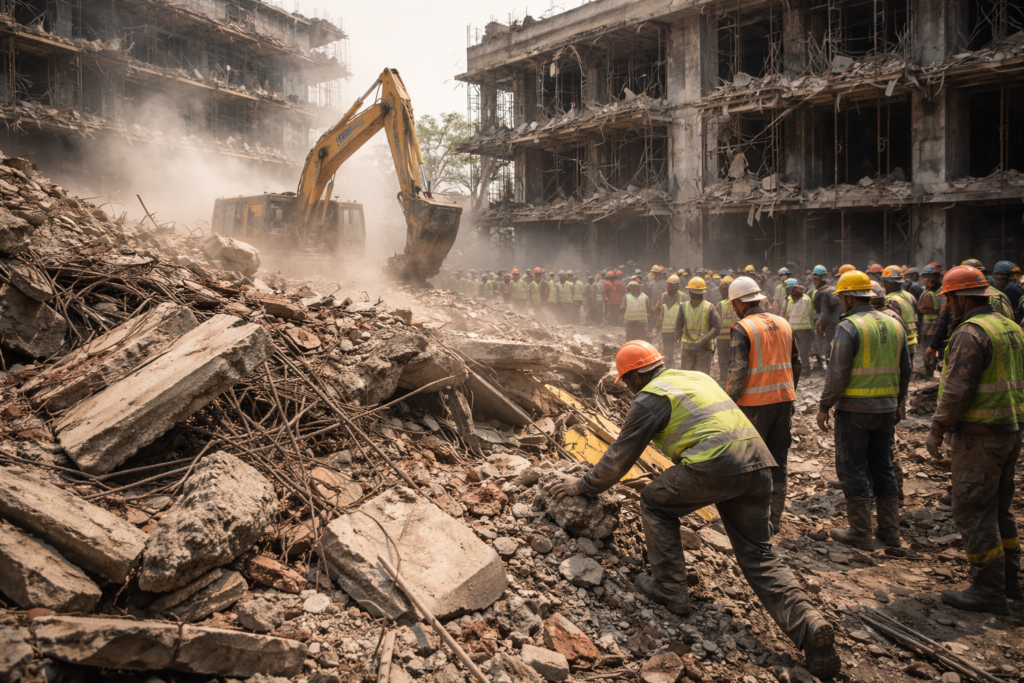
As reported in the news coverage, the South C collapse raised concerns around workmanship, compliance with approved plans, site supervision, and material quality. Months later, the Karen collapse despite taking place in a high-end area where many would assume stricter controls, killed two people and injured several others, with preliminary findings pointing to structural failure linked to inadequate formwork and substandard materials, including timber supports used where steel props were required for a critical slab. These details matter because they show that unsafe construction is not limited by neighborhood, cost of land, or social status. Risk travels wherever standards are treated as optional.
The pattern is as disturbing as it is familiar. Plans may be approved, but construction deviates. Supervision may be required, but qualified professionals may be absent or ignored. Materials may be specified, but substitutions happen quietly. Temporary works, formwork, propping, and supports may be essential at key stages, yet are treated as a place to save money. These are not accidents in the pure sense. They are failures of discipline, accountability, and respect for the most basic duty in any workplace: to ensure people go home alive.
Occupational fatalities and serious injuries do not end at the site gate. One death can destabilize an entire household, force children out of school, and leave families with permanent financial and emotional burdens. Multiply that across repeated incidents and you begin to see the wider national impact, millions of families living with loss, disability, and hardship that did not have to happen. In construction especially, where hazards are high and margins are pressured, a weak safety culture becomes a pipeline to preventable tragedy.
Health and safety, when properly implemented, is not an “add-on” or a box to tick. It is the practical discipline that turns safety from a promise into a daily reality. Strong safety systems require competent planning before work begins, credible risk assessments that actually guide site decisions, and continuous monitoring during every stage of construction from excavation and foundation work to slab casting and load-bearing operations. They require temporary works to be treated as engineered safety-critical systems, not improvised solutions. They require quality assurance that verifies materials and workmanship, rather than assuming compliance. Most importantly, they require the authority to stop unsafe work immediately, without intimidation, negotiation, or delay.
However, health and safety cannot function in isolation. Safety officers cannot succeed where leadership is indifferent. Engineers cannot protect life where their designs are altered on site without consequence. County oversight cannot deter wrongdoing if inspections are undermined, underfunded, or corrupted. And the law cannot prevent future collapses if accountability only appears after lives have already been lost. Africa must move from reaction to prevention, and that shift must be visible on sites, in inspection regimes, and in courtrooms.
ASHEPA calls for a renewed continental and national commitment to prevention in construction. This means inspections that are consistent and meaningful, especially at critical structural stages. It means enforcing professional accountability so that culpability leads to real sanctions, not temporary headlines. It means demanding evidence, testing, documentation, and verified compliance before work proceeds. It means protecting workers, nearby communities, and whistleblowers who report unsafe practices early. And it means treating every collapse as what it truly is: a failure of responsibility long before concrete and steel gave way.
The collapses in South C and Karen in Nairobi are warnings written in rubble. If Africa continues to treat safety as paperwork and punishment as optional, these tragedies will repeat. But if we choose prevention through strong enforcement, credible professionalism, and serious occupational health and safety practice, then lives can be protected, families can be spared, and the construction sector can become a symbol of progress rather than recurring grief.
At ASHEPA, our message is simple and non-negotiable: every life at the workplace matters. No deadline, no budget, and no profit margin is worth a human being.